If you’ve ever walked through a busy warehouse or distribution center, you’ve probably seen a stand-on reach truck zipping down an aisle, lifting pallets from high shelves, and pulling off maneuvers that look way faster than you’d expect for such a compact piece of equipment. As a supplier of stand-on reach trucks, I get asked this question all the time: How fast can these machines actually travel? It’s not a trivial one—speed in a warehouse is a balance between efficiency, safety, and the ability to get more done in a day without risking damage to goods, racks, or your team. Let’s break this down, not just with numbers, but with the real-world context that matters to anyone running a warehouse. Stand On Reach Truck
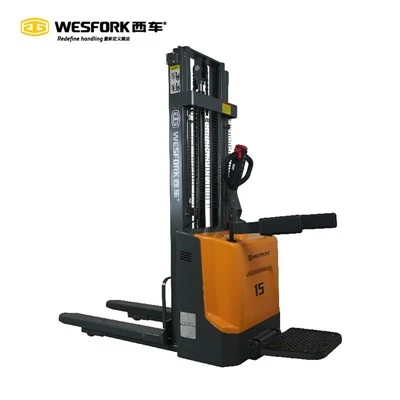
First, let’s start with the basics: What’s a stand-on reach truck, and how is it different from other forklifts? If you’re not familiar, stand-on models are designed for narrow-aisle operations, where space is tight and every inch counts. Unlike traditional sit-down forklifts, the operator stands on a small platform instead of sitting in a cab. That compact design means these trucks can work in aisles as narrow as 6 feet in some cases—way narrower than the 10+ feet needed for sit-down reach trucks. That narrow aisle capacity is a big part of why they’re so popular, especially for e-commerce fulfillment centers and grocery warehouses where storage density is key.
Now, speed. The maximum travel speed of a stand-on reach truck isn’t a one-size-fits-all number. Most standard models top out at around 8 to 10 miles per hour (mph) when they’re empty. That’s faster than you might think—about the pace of a casual bike ride. But here’s the catch: That maximum speed is almost never used in actual operation. When a stand-on reach truck is fully loaded, that top speed drops, and it drops a lot. A loaded stand-on reach truck carrying a standard 48×40 inch pallet (the most common size in North America) can only reach about 5 to 6 mph. Why the difference? The lift trucks (as they’re often called) have built-in stability controls, especially for reach models, because when you extend the mast to reach pallets on high shelves—some as high as 40 feet or more—the truck’s center of gravity shifts. Manufacturers limit speed to prevent tipping, even at lower heights, and that limit gets stricter the heavier the load or the higher you reach.
But speed isn’t just about the truck’s maximum mph. There’s another critical factor that most people overlook: acceleration. Stand-on reach trucks don’t take long to get up to speed, which is a big advantage in tight aisles where operators don’t want to wait for the machine to move. A good model will go from 0 to 6 mph in less than a second—fast enough to keep up with the pace of a busy warehouse without feeling jerky. Deceleration is just as important, though. Modern stand-on reach trucks have regenerative braking, which slows the machine down when the operator releases the throttle, and emergency brakes that engage automatically if the truck detects a sudden change in direction or too much speed for the load. That’s a safety feature that’s non-negotiable for our products, because a collision with a rack or a coworker can cost far more than a few minutes of saved time.
Now, let’s talk about when speed is adjusted, because that’s where the science gets practical. Many modern stand-on reach trucks have adjustable speed settings that operators or warehouse managers can tweak based on the aisle conditions. For example, in areas where pedestrians are moving—like near loading docks or order picking stations—you can set the maximum travel speed to as low as 2 mph. In the core storage aisles, where traffic is mostly just lift trucks moving loaded pallets, you can crank it up to the manufacturer’s recommended maximum for loaded operation. Some models even have built-in sensors that automatically adjust speed when the truck detects a load, or when it approaches a corner or an intersection. That’s a huge step up from older models, which had fixed speed limits that either were too slow for efficiency or too fast for safety.
I want to be clear: The numbers I’m talking about aren’t just pulled out of thin air. They’re based on ANSI (American National Standards Institute) standards for industrial lift trucks, which set minimum safety requirements for speed, stability, and operation. ANSI’s standard for reach trucks (B56.1) specifies that a stand-on reach truck must have a speed control system that limits travel speed when the mast is extended beyond a certain height, and that the truck must be stable at all operating speeds. That’s why our line of stand-on reach trucks undergoes rigorous testing to meet these standards, including stability tests at maximum speed with a full load, to make sure the machine won’t tip even when operated as designed.
But here’s the real question for warehouse operators: Does a faster stand-on reach truck actually make your operation more efficient? On paper, a 10 mph empty speed sounds great, but in a 50,000 square foot warehouse with aisles that are 7 feet wide, how much time do operators actually spend moving the truck empty from one end of the aisle to another? A study by the Material Handling Industry (MHI) found that the average stand-on reach truck operator spends only about 15% of their time traveling empty. The rest of the time, they’re loading, unloading, adjusting the mast, or moving slowly through crowded aisles. So even if a truck can go 10 mph, it’s only going to save you a few minutes a day—if that—compared to a model that’s optimized for loaded speed and maneuverability. The sweet spot for most operations is a stand-on reach truck that can hit 8 mph empty and 6 mph loaded, because that balances speed with the ability to turn in tight spaces and stop quickly when needed.
I also get asked a lot about electric vs. propane stand-on reach trucks, because fuel type can affect speed. All modern stand-on reach trucks are electric these days—propane models are mostly a thing of the past for narrow aisles, because propane engines produce emissions and are too bulky for tight spaces. Electric stand-on reach trucks have more consistent speed, too. Propane engines can have lag when accelerating, and their top speed drops as the tank gets low, which is a headache for operators. Electric models use lithium-ion batteries now, which charge in as little as 2 hours and provide consistent power across the entire charge. That means no speed lag, no unexpected slowdowns mid-shift, which is why all the reliable stand-on reach trucks on the market now use electric power.
But let’s talk about what can go wrong if you try to push a stand-on reach truck too fast. I’ve seen warehouses cut corners on speed limits, and it never ends well. A few years back, a customer of ours tried to run their stand-on reach trucks at 12 mph in their aisles, and one of the operators missed a corner, crashed into a rack, and damaged 12 pallets of high-value electronics. The repair cost for the rack was $15,000, the pallets were worth another $8,000, and they lost two days of operation to clean up the mess. That’s why we always emphasize that speed has to be matched to the environment. If your warehouse has a lot of pedestrian traffic, slow down. If your aisles are extra tight, even for stand-on models, keep the speed lower. The best operators know when to go fast and when to slow down, and a good stand-on reach truck gives them the flexibility to do that.
Now, if you’re in the market for a stand-on reach truck, here’s what you should look for in terms of speed and safety. First, check the maximum empty and loaded speed, but don’t just go for the highest number. Look for adjustable speed controls, regenerative braking, and stability sensors that adjust speed based on load and mast height. You should also test the truck in your own aisles if you can. A truck that works great in a 7-foot aisle might feel too fast in a 6-foot aisle, so seeing it operate in your space will give you a better idea of what speed is right for you.
At the end of the day, the question “how fast can a stand-on reach truck travel?” isn’t just about a number. It’s about balancing efficiency, safety, and the specific needs of your warehouse. A truck that’s too slow will slow down your picking and put-putting times, costing you money. A truck that’s too fast risks accidents, downtime, and damage. That’s why as a stand-on reach truck supplier, we build our models to hit that sweet spot: enough speed to keep operations moving, built-in safety features to protect your team and your goods, and the maneuverability to work in the narrow aisles that modern warehouses need.
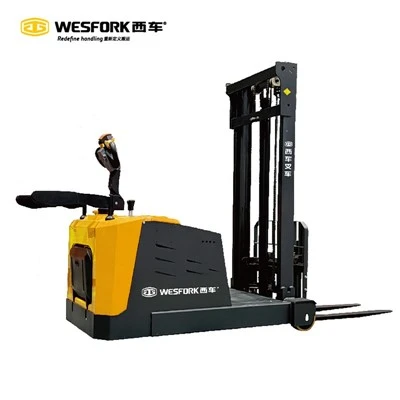
If you’re ready to look at stand-on reach trucks that fit your warehouse’s needs, I’d be happy to walk you through our line, answer any questions about speed, safety, or customization, and help you find the right model for your operation. Don’t hesitate to reach out to start a conversation about what works for your team.
Electric Stacker Forklift References
- ANSI B56.1-2020, Safety Standard for Industrial Lift Trucks
- Material Handling Industry (MHI), Narrow-Aisle Lift Truck Efficiency Report, 2022
- Occupational Safety and Health Administration (OSHA), Forklift Safety Guidelines for Stand-On Reach Trucks, 2021
WESFORK Industries (Zhejiang) Co., Ltd.
As one of the most professional stand on reach truck manufacturers and suppliers in China, we also support customized service. Please feel free to wholesale high quality stand on reach truck for sale here from our factory. For price consultation, contact us.
Address: 277#Yinhu Road,Yinhu Street,Fuyang District,Hangzhou City,Zhejiang Privince,China
E-mail: sulin@wesfork.com
WebSite: https://www.wesforkintl.com/
